CORE HL7 Postmaster

Created with the CORE HL7 API Libraries for .Net 8
For the CORE HL7 Postmaster we define the End Point of a HL7 Message as the final destination point to which we can possibly deliver the message before another process of some kind must take over the handling of that message. In the Postmaster an End Point can be either a Closed End Point or an Open End Point.
❖A Closed End Point is an End Point where the Postmaster is responsible for consuming each HL7 message (IE it deletes the HL7 message data files). Example: A TCP/IP Sender Destination, this type of destination takes a final action by delivering the HL7 message over TCP/IP to a waiting HL7 Listener. After it successfully completes this action it will consume the HL7 message.
❖An Open End Point is an End Point where the Postmaster DOES NOT consume the HL7 Messages, but leaves them in place as discrete HL7 data files. Example: A Folder Destination, a Postmaster delivers a HL7 message data file to the folder and leaves it there for some other process to consume.
Why is this important? If it's not important to you, it is important to us. See System Watch for more information.
Consider the scenario where you set up a Postmaster which consists of ONLY a HL7 TCP/IP Listener Data Source like the example shown below.
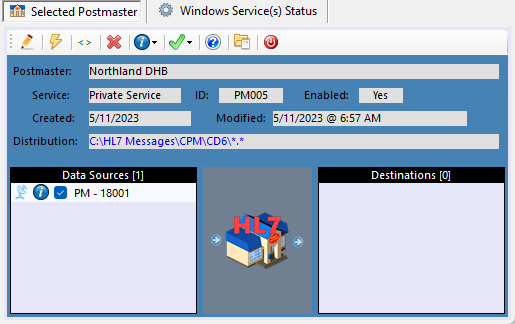
HL7 Listener Data Source
In the Postmaster shown above the HL7 Listener Data Source receives HL7 messages over TCP/IP and deposits them each in the Distribution Folder: C:\HL7 Messages\CPM\CD6\*.* as a discrete HL7 message file with a .HL7 extension. So when this Postmaster receives a HL7 message, the Distribution Folder IS the Open End Point, the final point to which this Postmaster is capable of delivering that message. The messages are left there for another process to consume.
CORE HL7 Postmaster Open End Points
Any Postmaster which contains NO Destinations (like the example shown above) has the Distribution Folder as an Open End Point.
Folder Destinations. By their very nature (messages are placed into a folder) this is an Open End Point.
Rubbish Bin Destinations (only IF the Rubbish Bin has been configured to use a Data Folder). If you opt to save "Rubbish" messages to a folder, then you are responsible for consuming those messages.
Undeliverable Messages. You have to watch out for these.
CORE HL7 Postmaster Closed End Points
TCP/IP Sender Destinations. Messages are delivered to a HL7 Listener and then consumed.
TCP/IP IPSec Sender Destinations. Messages are delivered to a HL7 IPSec Tunnel Listener and then consumed.
CORE SQL Schema Destinations. Messages are imported into the CORE MS SQL Schema database and then consumed.
Rubbish Bin Destinations (only if the Rubbish Bin has NOT been configured to use a Data Folder). Messages which match the Rubbish Bin's Matching Instructions are consumed.
