Starting in 2025 you can now use the CORE HL7 C# Script subsystems in the CORE HL7 TCP/IP Listener. This means that you can create a CORE HL7 Script which can examine and manipulate HL7 messages as they are received AND (if needed) cause your CORE Listener to REJECT messages if something you need is missing or invalid. You can also examine and even manipulate the HL7 Acknowledgement message that the CORE Listener will send back to the sender and even OVERRIDE whether or not your Listener will send back an ACK at all!
If your script is a Type 3 (Listener) script you can run a Listener Simulation. To do this just load your Message Store with a reasonable number of HL7 messages that represent whatever scenario your script was written to address and then just click the  button on the main window toolbar.
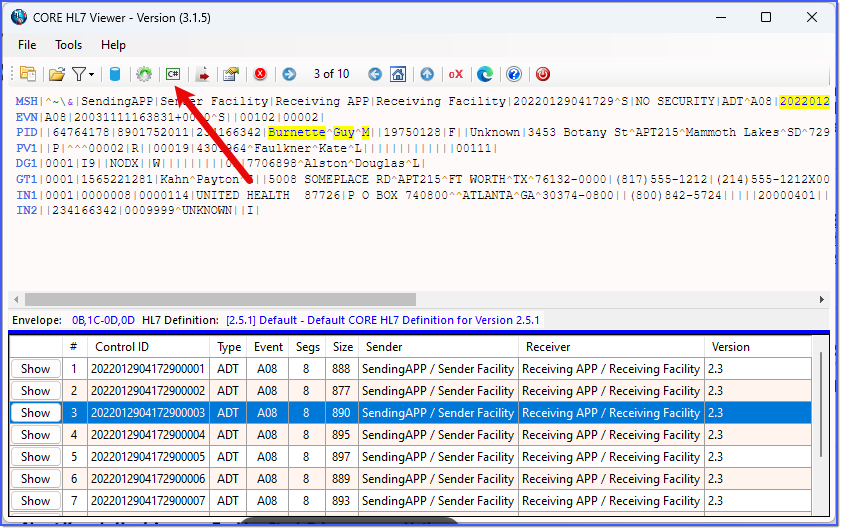
Create and Run custom scripts you write in c#!

Running Your Script
In the Script Runtime Window you just select which Type 3 script from your Script Library you want to run. Then make sure that you check the Simulate HL7 Listener box. When you're ready, click the Run Script button. Your script will run through to completion executing ONCE for each HL7 message you indicated.
Once your script has completed running (or been canceled by you) the Runtime Results window will appear.
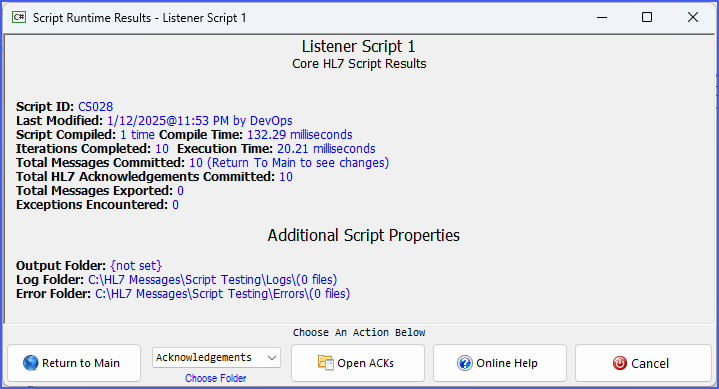
Runtime Results
Examine this window closely because it gives you a LOT of information about what happened when your script ran. It will tell you how long it took to compile your script, how many iterations were completed, and the total execution time for all of those iterations. In the results screenshot above you can see that it took 132.29 milliseconds to compile the script (this is only done ONCE), then there were 10 iterations (once for each HL7 message loaded in the viewer), and these 10 iterations took a total of 20.21 milliseconds to run. That's VERY fast, basically just 2 milliseconds per iteration!
From this window you can also open any of the Script Folders which you have set when creating your script (see Script Folders). Just select which folder you want to open and click the Open Folder button.
But there is more! In the section where you Choose Folder you will have another option, Acknowledgements, which you can select. Selecting this option changes the button from Open Folder to Open ACKs. You can click this button to open all of the HL7 ACK messages created in your session in a new CORE HL7 Viewer Window! If you do this, then click Return to Main you can compare the HL7 messages received (simulated) with the HL7 Acknowledgement your CORE HL7 Listener would return.
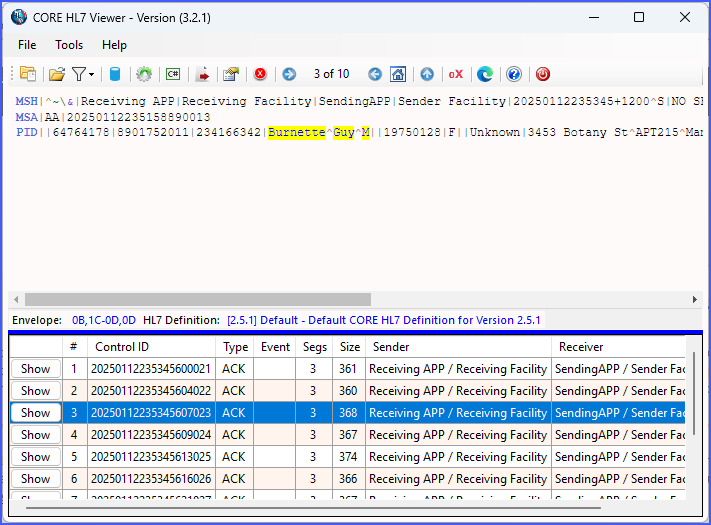
Simulated HL7 Acknowledgements
In the example you see in the screenshot above, the CORE HL7 Script actually CHANGED the default ACK message, and added the PID segment from the original HL7 message into the ACK. This is just for example purposes to show the capabilities of the CORE HL7 Scripts.
Try this yourself just download the CORE HL7 TCP/IP Listener and give it a go!
